
EXPOSED: WBC Sanctions Doping Cheat for Eurasia Title Despite 3-Year Ban from Four Independent Bodies
Olympic gold medalist Lazizbek Mullojonov fought for WBC belt while actively suspended by ITA, Middle East Professional Boxing Commission, VADA, and World Boxing

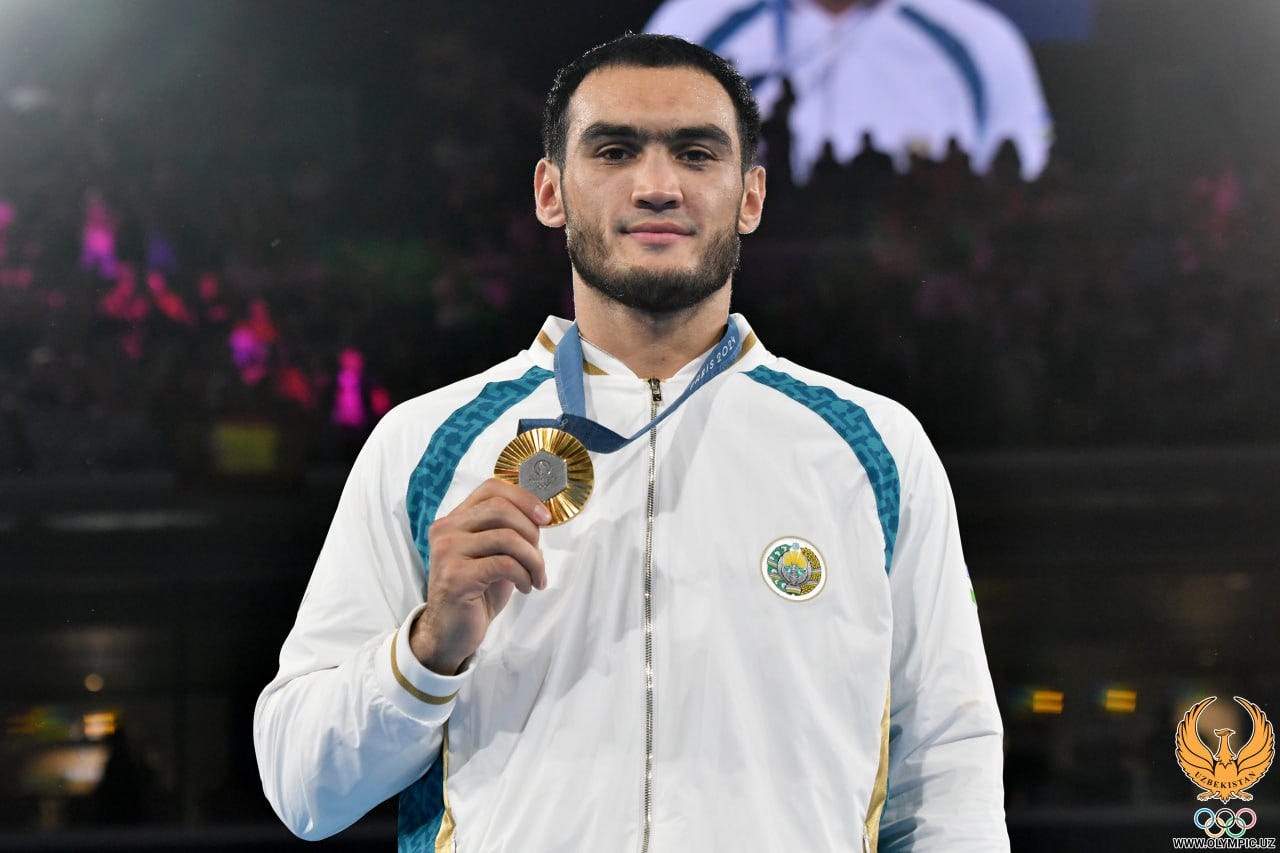
[NOTE: The following piece was submitted by an insider with direct knowledge of the subject matter who, for personal/professional reasons, chooses to remain anonymous. The information provided has been independently verified by the editor.]
Boxing loves a comeback story. But this is not one.
Lazizbek Mullojonov, the Uzbek heavyweight who won Olympic gold at Paris 2024, recently fought for the WBC Eurasia title in his home country. The problem? He was under an active 3-year doping ban.
Not one. Not two. Four independent bodies have flagged Mullojonov for violations. The International Testing Agency (ITA) handed him a three-year suspension. The Middle East Professional Boxing Commission – which was the working commission in charge of the WBC Grand Prix – issued a one-year administrative ban (listed as “UAE Boxing Commission” on Boxrec). VADA (Voluntary Anti-Doping Association) returned a positive test for the anabolic steroid methasterone. World Boxing enforced the ITA ruling.
And the WBC? They sanctioned the Eurasia title fight anyway.
---
The Doping Case: Clear, Repeated, Documented
Mullojonov’s violations are not ambiguous.
On June 11, 2025, during the WBC Grand Prix in Riyadh, Saudi Arabia, VADA collected a sample from the boxer. The result: methasterone – a potent anabolic-androgenic steroid classified by WADA as a non‑specified substance under category S1.1. There is no accidental ingestion defense for methasterone. It is a straight‑line performance enhancer.
The ITA, acting on behalf of World Boxing, launched proceedings. On November 29, 2025, they announced a three‑year period of ineligibility – from July 22, 2025 to July 21, 2028. Every competitive result achieved by Mullojonov after June 11, 2025 was disqualified.
The only reason the ban was not the standard four years? Mullojonov admitted the violation early. That admission bought him a single year off his sentence. It did not erase the violation.
Separately, the Middle East Professional Boxing Commission – the body in charge of the WBC Grand Prix – issued its own one‑year administrative suspension running until June 21, 2026. (Boxrec records this suspension under “UAE Boxing Commission.”)
Four bodies. Four findings. One athlete.
---
The WBC Grand Prix: Fighting While Dirty
Here is where the timeline becomes damning.
Mullojonov provided his positive sample on June 11, 2025. Ten days later, on June 21, 2025, he stepped into the ring at the Cool Arena in Riyadh to fight Youness Baalla in the WBC Grand Prix – a tournament sanctioned and promoted by the WBC.
He fought with an active doping violation in his system.
The provisional suspension did not formally begin until July 22, 2025. That is the WBC’s standard defense: “The process was not yet complete.” But the positive test was already known. The sample had already been analyzed. The result was already flagged.
A serious anti‑doping program would have provisionally suspended him before the Baalla fight. The WBC did not.
---
The Eurasia Title: Sanctioning an Active Suspension
Despite the ITA’s three‑year ban – which runs through July 2028 – and the Middle East Professional Boxing Commission’s one‑year suspension – which runs through June 2026 – the WBC went ahead and sanctioned Mullojonov for the WBC Eurasia heavyweight title in Uzbekistan.
Let that sink in.
· ITA: You are banned until 2028.
· Middle East Professional Boxing Commission: You are suspended until 2026.
· VADA: You tested positive for anabolic steroids.
· World Boxing: We uphold the ITA ban.
· WBC: Here is your title shot.
The WBC Eurasia belt is a WBC regional title. It carries ranking points and often leads to world title opportunities. By sanctioning this fight, the WBC signaled that its own anti‑doping commitments are optional – especially when the fighter is an Olympic gold medalist from a strategically important boxing nation.
---
If you enjoy an independent boxing media, consider becoming a paid subscriber (only $6 a month/$70 a year). Paid members help keep this site alive and get access to extra columns, deeper analysis, and subscriber-only posts.
The Boxrec Problem: Watching It Happen
Mullojonov’s profile on Boxrec.com lists his suspension: “suspended by UAE Boxing Commission until 2026-06-21” – the same suspension issued by the Middle East Professional Boxing Commission.
The information is there. But it is a passive note on a digital record card. It does not block promoters. It does not stop sanctioning bodies. It does not flag the fighter as ineligible when a WBC official clicks “approve.”
Boxrec is not the villain here. Boxrec is a ledger. It records what commissions and sanctioning bodies tell it. The failure is not in the record‑keeping – it is in the complete absence of anyone required to act on those records.
A fighter can be suspended on Boxrec at 9 AM and fight for a WBC title at 10 PM. The database does not stop him. The WBC chooses not to.
---
The WBC’s Pattern of Enabling
Mullojonov is not an isolated case. He is the latest entry in a long, unbroken line.
Fighter Violation WBC Response:
Ryan García Ostarine (positive after Devin Haney fight) Returned as #1 contender
Francisco Rodríguez Jr. Heptaminol, octodrine, oxilofrine (two separate failures) Probation + $500 fine
Jaime Munguia Testosterone metabolites One year of “observation”
Lazizbek Mullojonov Methasterone + 3-year ITA ban + 1-year Middle East Professional Boxing Commission ban Eurasia title shot
The WBC’s “Clean Boxing Program,” launched in 2016 with promises of rigorous testing and severe penalties, has become a public‑relations document – not an enforcement mechanism.
When a fighter tests positive, the WBC investigates. When the investigation concludes, the punishment is a wrist slap. When the fighter serves a ban from another body, the WBC ignores it. When sanctioning fees are due, the WBC collects them.
---
The Commission Failure: Who Was Watching?
The Uzbekistan fight did not happen in a vacuum. Local commissions approved it. The WBC Eurasia federation – recently rebranded and placed under the leadership of Uzbek sports figure Gafur Rakhimov – sanctioned it.
Where was the oversight?
The ITA ban applies globally. It is not a “suggestion.” The Middle East Professional Boxing Commission suspension applies to any fight under their jurisdiction – but the WBC chose to move the fight to Uzbekistan, where the Middle East commission’s ruling carries no direct authority.
This is jurisdictional shopping. And the WBC facilitated it.
---
The Bottom Line
Four independent bodies – the ITA, the Middle East Professional Boxing Commission, VADA, and World Boxing – found Lazizbek Mullojonov in violation of anti‑doping rules. Three of them issued active suspensions. One documented a positive test for an anabolic steroid.
The WBC sanctioned him anyway.
This is not a failure of process. This is a failure of will. The WBC has the power to deny sanctioning. It has the power to pull rankings. It has the power to enforce reciprocity with other anti‑doping bodies.
It chooses not to.
And until the boxing media demands accountability – until promoters face consequences, until Boxrec becomes an enforcement tool rather than a historical record, until the WBC’s “Clean Boxing Program” means something more than a press release – fighters like Lazizbek Mullojonov will keep fighting. Bans will keep being ignored. And the sport will keep poisoning itself.
The WBC Eurasia title now belongs to a fighter serving a three‑year doping ban.
That is not a victory. That is an indictment.
---
Sources: ITA public disclosure (November 29, 2025); Boxrec.com (Lazizbek Mullojonov profile, suspension flagged as “UAE Boxing Commission”); VADA testing records (June 11, 2025); WBC Grand Prix bout sheets (June 21, 2025); Middle East Professional Boxing Commission suspension notice; World Boxing anti‑doping rulings.